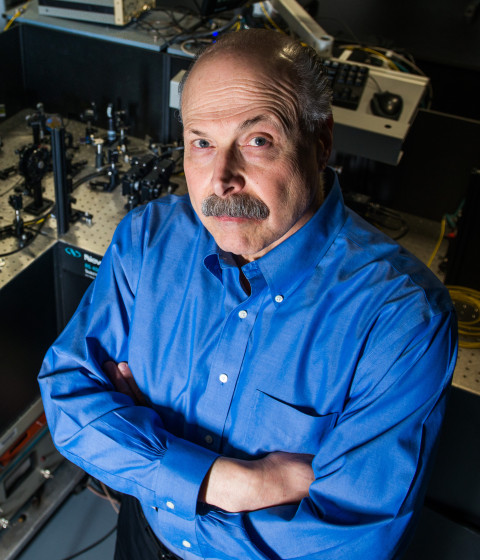
The Falling Walls Foundation has named University of Chicago Professor David Awschalom a recipient of the prestigious Falling Walls Science Breakthrough of the Year in Physical Sciences for a pioneering body of work that broke the wall between quantum technology, molecules, and proteins. The international award, given by a Berlin-based organization that convenes leaders in science, business, and society to promote breakthrough thinking, recognizes research that bridges disciplines to solve global scientific challenges.
David Awschalom, Liew Family Professor of Quantum Engineering and Physics, UChicago PME; director of the Chicago Quantum Exchange; and senior scientist, Argonne National Laboratory
Awschalom, the Liew Family Professor of Quantum Engineering and Physics at UChicago’s Pritzker School of Molecular Engineering and the director of the Chicago Quantum Exchange, has spent nearly a decade collaborating across disciplines to develop processes for turning molecules and proteins into qubits — an expansive project that could ultimately improve how we detect and fight disease. (Qubits, or quantum bits, are the building blocks of quantum technology.)
The work represents a challenging intersection between quantum technology — which demands pristine atomic precision — and biology and chemistry, fields in which the environments are often difficult to control. The results enable unprecedented control over quantum states within living systems, laying the foundation for ultra-precise molecular sensing, biocompatible quantum sensors, and new frontiers in biomedical imaging.
“This research highlights the immense potential at the intersection of quantum science and molecular biology,” said Julian Solway, MD, Emeritus Professor of Medicine at the University of Chicago; former founding director of the Institute for Translational Medicine; and current co-director of the UChicago Berggren Center for Quantum Biology and Medicine. “By leveraging protein architectures for qubit systems, this work opens entirely new avenues for observing cellular dynamics and disease processes at an unprecedented, single-molecule scale.”
‘You simply change the factory’
The work began in 2017 when Awschalom won a Vannevar Bush Faculty Fellowship, a five-year award from the US Department of Defense that supports new ideas “where researcher creativity intersects with the unknown.” Solid-state qubits are often made from the top-down: starting with conventional semiconductor materials and processing them with extreme precision until perfectly identical states are obtained. The idea for the Vannevar Bush fellowship was to try the opposite: building the qubits from the bottom-up. Instead of taking bulk material and winnowing it down, what if the qubits were grown like plants?
“You simply change the factory,” said Awschalom. “Chemists have been doing it for many years in other systems; why couldn’t we use it for quantum science and technology?”
The idea took work and time to get off the ground. The first major breakthrough came in 2020, when a team that included Awschalom and Danna Freedman, then a professor of chemistry at Northwestern University, engineered synthetic molecules that could be controlled and used as qubits. Several years later, a collaboration with Jeffrey Long, a professor of chemistry at the University of California, Berkeley, led to the development of molecular qubits that could bridge magnetism and light and operated at the same wavelengths as telecommunications technology. Then, last year, Awschalom and a team that included UChicago PME Associate Professor Peter Maurer broke the barrier between quantum and biology, developing a revolutionary method of creating qubits using genetically encodable proteins. The cell itself can generate these proteins, which can be designed to bind to targets of interest inside living systems.
“These achievements are a powerful testament to what happens when you embrace high-risk, boundary-pushing science,” said Danna Freedman, now the Frederick George Keyes Professor of Chemistry at the Massachusetts Institute of Technology (MIT). “Creating molecular qubits required us to bridge synthetic chemistry with quantum engineering in ways that hadn't been done before, but seeing these risks pay off opens extraordinary new frontiers for physics, biology, and medicine.”
Persistence and patience
Awschalom described the research as incredibly challenging, marked by long stretches — sometimes years — of trial and error between key milestones. But he credits the persistence and bravery of his graduate students and collaborators for transforming frustrating experiments into eventual breakthrough success.
“It required patience,” he said. “It’s a testament to our extraordinary graduate students who had the courage to stick with projects that failed for years; the strong, interdisciplinary collaborations that bring together a wide variety of expertise; and the funding avenues that allowed us to really explore the possibilities.”
The Falling Walls Science Breakthrough of the Year award celebrates work that “pushes the boundaries” of our understanding of the universe, “driving technological frontiers.” Awschalom and his collaborators emphasized that this would not have been possible without a willingness to embrace long-term scientific risk and work together to explore the areas between disciplines.
“One could never accomplish this without strong collaborations,” Awschalom said. “In modern science, you need many different skillsets to make boundary-pushing discoveries. These days a great deal of important science emerges from the gray areas between the traditional spaces — for instance, where physics intersects chemistry, which intersects biology, and so on. Falling Walls shines some light on the idea that breakthroughs can come from a willingness to take big risks and collaborate across fields. I’m honored to have been selected.”
Awschalom will present the findings with other award winners at the annual Falling Walls Science Summit in Berlin this November. Read his finalist interview on the Falling Walls website.